
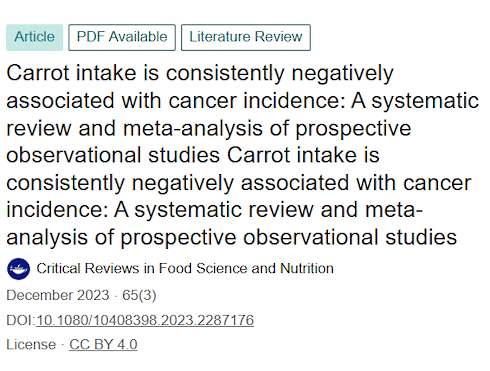
Case study
The researchers had access to data on 4.7 million study participants. Of these, 138,917 had been diagnosed with cancer.
Results
Study participants with the highest carrot intake had a ten percent lower risk of cancer than those with the lowest intake.
That may not seem like much, but it is important to bear in mind that the risk of cancer has become quite high in 'developed' countries. Worldwide, one in five people receives a cancer diagnosis. In a highly 'developed' country like the Netherlands, that figure is as high as one in two.
The picture changes when the researchers focus solely on 33 prospective observational studies in which the authors not only estimated carrot intake but also measured alpha-carotene concentrations in the participants' blood. In that case, high carrot intake reduces the risk of cancer not by ten percent, but by twenty percent.
Click on the figure below for a larger version.
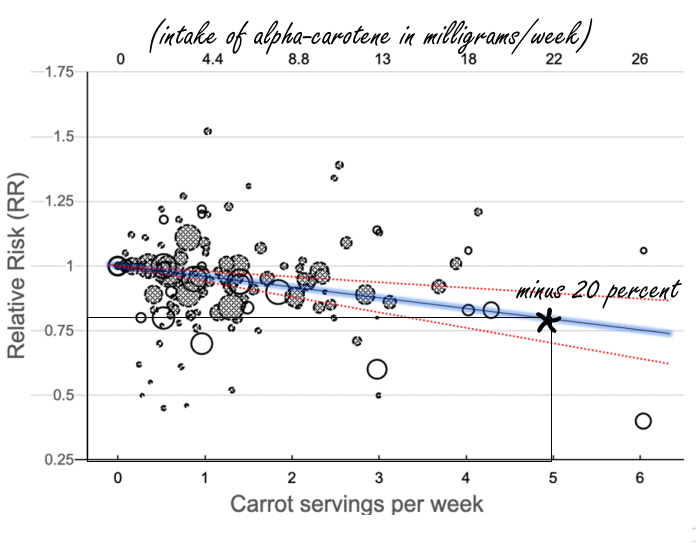
'High intake' is defined here as a diet that includes sixty grams of carrots daily. That amounts to approximately four hundred grams of carrots per week.
Not alpha-carotene?
Although the researchers observe associations between carrot intake, blood alpha-carotene levels, and a reduced risk of cancer, epidemiological studies provide little evidence of a protective effect from alpha-carotene itself. Alpha-carotene appears to offer protection primarily in vitro.
The British researchers therefore suspect that high alpha-carotene levels serve as a marker for high carrot intake - but that alpha-carotene is not the primary protective substance found in carrots. They have a strong suspicion as to which group of protective substances in carrots is actually the most important.
"To our knowledge the only proposed anti-cancer phytochemicals of which carrots are major sources (more than fifty percent of dietary intake) are the polyacetylenes falcarinol, falcarindiol and falcarindiol-3-acetate," they write.

"Other apiaceous vegetables also contain polyacetylenes such as falcarinol and falcarindiol, but are consumed in much smaller amounts than carrots."
Conclusion
"The robust linear relationships between carrot exposure and cancer risk reduction can be used directly for public health recommendations," summarize the British. "When five servings per week reduced the risk of cancer by 20 percent, then 'a carrot a day' really did keep the oncologist at some distance," they write.


