
ergo-log.com

Definition: "An ergogenic aid is any substance or phenomenon that enhances performance "

about us

/

contact

/

Ergo-Log


Listening to music reduces the risk of dementia

If you listen to music or the radio almost constantly, you may reduce your risk of developing dementia. This effect may be greater the more education you've received in your life.


Listening to music reduces the risk of dementia


Study
Epidemiologists from Monash University followed 10,893 Australians aged 70 and over for approximately 7-10 years. All participants were mentally healthy at the start of the study.

At the start of the study, participants indicated on a questionnaire how often they listened to music or the radio or played an instrument. They could choose between never, rarely, sometimes, often, and always.

Based on their responses, the researchers divided the participants into three groups: one that never, rarely, or sometimes listened to music or the radio [Group 1], one that often listened to music or the radio [Group 2], and one that always had music or the radio playing [Group 3].

The researchers used cognitive tests and the participants' medical records to determine whether they showed any cognitive signs of dementia at the end of the study period.

Results
Study participants who said they "always" listened to music or the radio had a 39 percent lower risk of dementia than participants in Group 1. The researchers adjusted for factors such as age, gender, and education level.

Playing an instrument reduced the risk of dementia by 35 percent, and the combination of listening and playing by 33 percent.

Click on the figure below for a larger version.
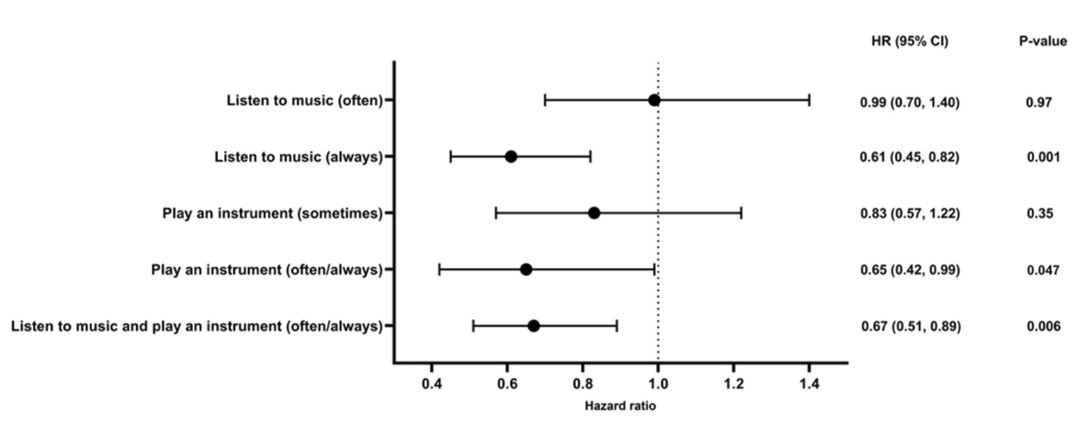

Listening to music reduces the risk of dementia


The protective effect of music in this study was about as strong as that of physical activity and social activity. It was weaker than that of not smoking and a higher education level.

Speaking of education, the researchers also found a link between education and the protective effect of music. In the group with more than 16 years of education, always listening to the radio or music reduced the risk of dementia by a whopping 63 percent.

The interaction between music and education was not significant (p = 0.15).
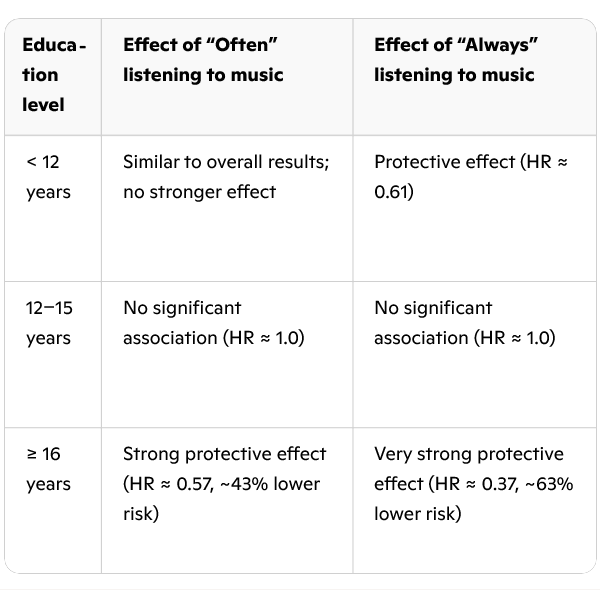

Listening to music reduces the risk of dementia


Mechanism
Listening to music activates multiple parts of the brain simultaneously. These parts are involved in emotions and memory, cognition and learning processes, and also in muscle control. [Neuroimage. 2012;59(4):3677-89.] As a result, music keeps a wide range of brain regions healthy.
More:
A meaningful life? Less cognitive decline due to aging (07.01.2024)
Social activity protects against dementia (26.10.2023)
Frequent contact with friends and family protects against dementia (06.08.2019)
Loneliness leads to first stages of dementia (09.02.2017)
Cynical over 65s more likely to develop dementia (21.06.2014)

Archives:
Alzheimer's & Dementia
Psychology
Music


Working in the garden may protect against dementia How over-60s can improve their cognitive abilities with curcumin Supplementing with Lion's Mane improves mental fitness in people over 50

Working in the garden may protect against dementia
People over 65 who work in their garden daily or almost daily have a quarter less chance of dementia than their peers who never garden.

How over-60s can improve their cognitive abilities with curcumin
People over 60 can improve their brain function by taking curcumin supplements, if they know how.

Supplementing with Lion's Mane improves mental fitness in people over 50
Lion's Mane, also known as Hericium erinaceus, is a mushroom that traditional Asian healers have used for centuries against forgetfulness and incipient dementia.