Back to microplastics
Yes, micro- and nanoplastics are released from plastic packaging. During the production, distribution, and transport of a PET bottle of soda, those particles are released due to mechanical stress. If you buy that bottle and leave it in the sun in a scorching hot car for a few days, there will be more of them. But even that is not the primary source of micro- and nanoplastics.
When you heat food in plastics, plastic particles are released in massive quantities. And that is where by far the majority of the micro- and nanoplastics we ingest daily come from. You should think of food heated in a microwave while in plastic packaging [Environ Sci Technol. 2023 Jul 4;57(26):9782-92.] or water that you boil in a plastic kettle. [npj Emerging Contaminants. 2025;1:16.].
The very highest values we found in the literature related to tea made with plastic tea bags. [Food Chem. 2025;466:142111.]
If you are not comfortable with micro- and nanoplastics, you now know the three most important strategies to reduce your exposure. Other measures, such as avoiding drinking coffee and tea from plastic cups [Environ Sci Technol. 2024 May 21;58(20):9013-4.] [Foods. 2024 May 17;13(10):1564.], have relatively little effect.
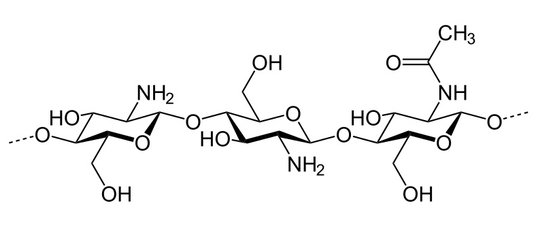
And of course, what you can also do is supplement with chitosan [structural formula below].
Study
During the two weeks the study lasted, the participants in the placebo group took two capsules without active ingredients every evening. The participants in the experimental group took two capsules containing 400 milligrams of chitosan each. They therefore consumed 800 milligrams of chitosan per day.
Just before and just after the supplementation period, the researchers determined the concentration of microplastics in the participants' blood.
Results
The researchers used a method that measures particles 700 nanometers or larger. The total mass of the measured microplastics decreased by 26.3 percent in the experimental group during the supplementation period.
In the control group, the researchers observed no significant shifts.
Click on the table below for a larger version.

This might work too
If chitosan supplementation does indeed reduce the concentration of micro- and nanoplastics in the body, there may be other natural substances that can achieve the same.
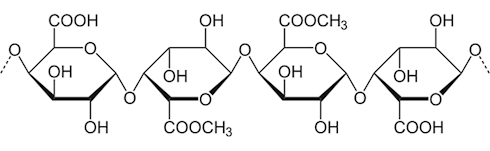
The most obvious candidate is alginate. Like chitosan, alginate forms a gel in the stomach. This could potentially bind hydrophobic plastic particles. Pectin and psyllium share second place on the list of candidates. These also form gels that we suspect can bind microplastics.