

Study
The participants were also quite overweight.
The Canadians divided their participants into two groups: a control group and an experimental group. For 12 weeks, participants in the control group ate whenever they wanted, while participants in the experimental group ate only during an eight-hour window.
In both groups, participants were free to eat whatever they wanted.
Results
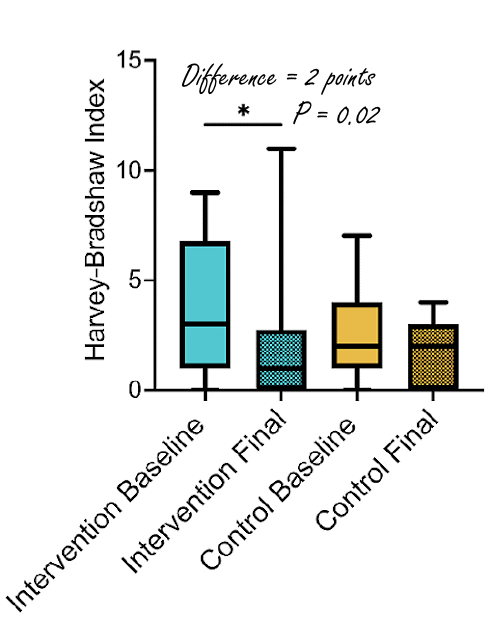
Although their disease was in remission, the participants still experienced symptoms. Doctors measured the severity of these symptoms using a standardized questionnaire, the Harvey-Bradshaw Index. Although the participants already scored low, the score in the experimental group dropped by another two points.
Thanks to the intermittent fasting, the participants had to go to the bathroom for 40 percent less often. They also experienced 50 percent less abdominal pain. The patients experienced this as a noticeable improvement.

Moreover, the participants lost some weight due to the intermittent fasting. Their BMI decreased by 0.9 points. Based on data we obtained from other studies, we estimate that participants in the experimental group lost 2-3 kilos.
The BMI of the control group did not change.
In the experimental group, scans showed a decrease in visceral fat.

This suggests that the disease itself - in Crohn's disease, chronic inflammation affects the intestines - did not disappear or improve with intermittent fasting.
The Canadians did observe an improvement in the gut flora in the experimental group. They found an increase in the number of microorganisms that produce butyrate.
Conclusion
"We acknowledge the pilot nature of this randomized controlled trial, with its modest sample size and short duration, which limits generalizability and supports interpretation as hypothesis-generating", the researchers write.
"Nonetheless, the magnitude of change observed within 12 weeks highlights time-restricted feeding is a feasible adjunctive nutritional strategy in Crohn's disease [...]."


