|
Definition: "An ergogenic aid is any substance or phenomenon that enhances performance "
|
|
||||||||
18.04.2014 |

|
|
Squat technique worsens with lots of reps and sets
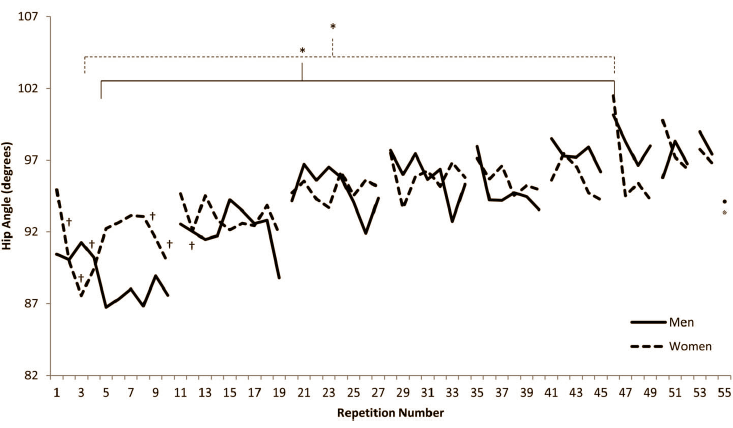
Hooper's subjects started by doing a set of ten reps of each exercise. Then they did a set of nine reps of each exercise. Then a set of eight reps of each exercise. And so on... you've got it. The subjects had to continue until they did a set of one rep of each exercise, so they did a total of 55 reps per exercise.
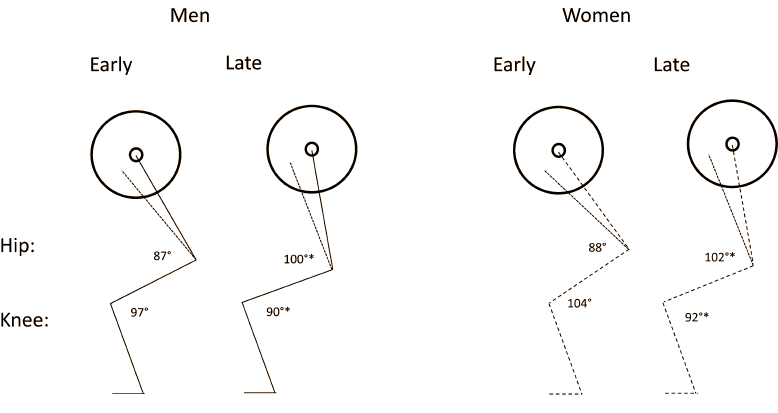
In his study Hooper looked at how the subjects performed the squat. He filmed his subjects – 12 men and 13 women who had been doing strength training for at least six months – while they did their squats, and noted the angle of their knee joint and the hip joint at the lowest point of the movement.
Hooper wondered whether such a voluminous schedule would tend to lead to sloppiness and possibly risky performance. And this was indeed what happened, although not in the way you might expect. The subjects' squat performance didn't become sloppier as the training session progressed and they became more tired, but was worse during the first phases of the workout.
During the first sets the subjects did not bend their knees deeply enough and didn't keep their backs straight either.
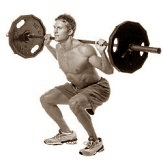
Squats are safer the more straight and vertical athletes can keep their back. Athletes achieve more muscle growth and gain more mass the deeper their squats are. So at the start of their workouts at least, the subjects did not perform squats well.
As far as the position of the back went: the subjects' hip angle was not optimal at the start of the workout, but improved as the session progressed.
"These technique changes are most likely a demonstration of self-preservation, where the squat movement is abbreviated when individuals are faced with high repetition programs", Hooper writes.
"Negative technique changes can be reversed with the prescription of lower repetitions, even in the face of extreme fatigue, but this prescription must be balanced with the need for strength gains", he advises. "Ultimately, if movement patterns are erratic during a resistance exercise, particularly under heavy loads, it seems in the interest of athlete safety that this workout design is performed with less technical exercises (such as resistance machine exercises) to keep potential injury risk at a minimum while still seeing the positive adaptations associated with such program design."
Source:
More:
|
|