|
Definition: "An ergogenic aid is any substance or phenomenon that enhances performance "
|
|
||||||||
02.08.2013 |

|
|
Piceatannol for endurance athletes – the EPO effect
The Koreans' study actually has nothing to do with sport, but everything to do with gut problems such as Crohn's disease and ulcerative colitis, in which the intestines are chronically inflamed. Animal studies have shown that increased activity of the transcription factor Hypoxia-Inducible Factor-1-alpha [HIF-1-alpha] [structural formula shown above] reduces the inflammation associated with colitis. HIF-1-alpha arms cells against oxygen deficiency and therefore increases their survival chances.
Piceatannol happens to be an analogue of resveratrol. Like resveratrol it's found in black grapes.
Bulk suppliers have had piceatannol in their catalogues for a number of years, so it probably won't be long before supplements containing powerful doses of piceatannol appear on the market.
Endurance athletes with a fetish for life sciences will be familiar with HIF-1-alpha. It makes the body synthesise more EPO and VEGF.
Cobalt chloride is an effective endurance drug as it induces free radical activity in the body, thereby boosting the concentration of HIF-1-alpha, and via HIF-1-alpha boosting the synthesis of EPO. [Br J Sports Med. 2005 Nov;39(11):872-3.]
Salidroside, a compound found in Rhodiola rosea, does the same - but in a way that probably has fewer health risks associated with it.
The researchers discovered that piceatannol sabotages the enzyme HIF-prolyl-4-hydroxylase. This enzymes cuts proline groups off from HIF-1-alpha molecules at a critical location, after which cellular machines chop up the transcription factor into amino acid pieces.
The potential EPO-boosting properties of piceatannol are not unique. Researchers from the same group published the results of an in-vitro study in 2007, in which the flavonoid quercetin had exactly the same effect on gut cells. [Mol Pharmacol. 2007 Jun;71(6):1676-84.]
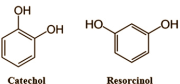
Enzymes attach sugar groups to piceatannol in the body, so that the kidneys can expel the compound. Animal studies show that the process is fast. [J Pharm Pharmacol. 2006 Nov;58(11):1443-50.] Certainly if the sugar groups attach themselves to the catechol group, you might wonder whether the compound doesn't become inactive.
The pathway diagram above suggests that EPO synthesis probably also increased.
Source:
More:
|
|