|
Definition: "An ergogenic aid is any substance or phenomenon that enhances performance "
|
|
||||||||
19.04.2010 |

|
|
Delay aging without hunger with life extenders in green apples
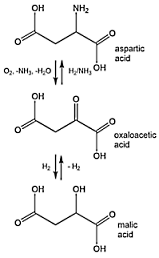
L-Malate, the organic acid that gives green apples their tart taste, extends lifespan. The microscopic worm Caenorhabditis elegans [see picture below] lives on average 25 per cent longer when a L-malate metabolite is added to its food, pharmacologists at the University of California San Diego discovered.
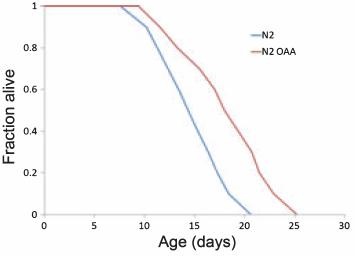
The researchers did an experiment with the worms to test their theory. The worms were given oxaloacetate in their food, at a concentration of 8 millimoles. Tests with 2 millimoles concentration had no effect, but at a higher concentration the worms lived for longer. Blue line [N2]: without oxaloacetate. Red line [N2 OAA]: with oxaloacetate.
The researchers repeated their experiments with mutant worms, in which the daf-16 gene had been deactivated. We humans have 4 of this gene, called FOXO. These are the genes that become active when you don't get enough to eat. They activate protective mechanisms. The worms whose daf-16 genes had been deactivated did not live longer when given apple acid.
Nor did the worms without the aak2 gene. We also have this gene, but it goes by the name AMPK. The gene codes for an enzyme that recharges AMP so that it becomes ATP again. But it does much more. AMPK is probably a cellular sensor, which warns cells when they have too little energy.
It seems that oxaloacetate imitates the effects of calorie restriction, the researchers conclude. The worms ate just as much and grew just as fast as the worms that did not get oxaloacetate in their food. So maybe oxaloacetate would allow humans to keep eating what they normally eat, and reach Methuselah type ages.
Based on a Japanese research article from 1968, the researchers suggest that humans can safely consume 1 g oxaloacetate daily. [Tohoku J Exp Med. 1968 Oct; 96(2): 127-41.] We are more inclined to put our money on the precursor L-malate. Arginine malate or something similar.
Source:
|
|