|
Definition: "An ergogenic aid is any substance or phenomenon that enhances performance "
|
|
||||||||
19.06.2011 |

|
|
Innervated muscle tissue reacts to steroids
It could be an accident, a knife-wielding idiot or a disease that causes damage to the nerves running from your brain to your muscle. The technical name for this is innervation. The researchers devised an experiment to find out whether administering an anabolic steroid could prevent muscle tissue atrophy when a nerve was severed.
The researchers cut through the nerves going to the hind legs of their test animals [Den]. They performed a similar operation in a control group, but did not sever the nerves [Sh].
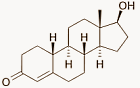
Then some of the experimental animals were given an implant that pumped nandrolone [Nandrolone]. The dose corresponded to the doses recommended in medical handbooks for humans. For nandrolone this is 50-200 mg/week. Another group of test animals was not given nandrolone [Vehicle].
During the first 14 days after the intervention it made no difference whether the rats received nandrolone or not. The muscle mass in the hind leg of all the animals atrophied. But after a month there was a difference: the rats that had been given nandrolone lost their muscle mass at a slower rate.

The figure above shows how much muscle mass the animals had after 56 days. The weight of the gastrocnemius was recorded.
The researchers discovered that nandrolone had no effect on the anabolic mechanism in the innervated muscle cells, but did reduce catabolic mechanisms.
Steroids not only reduce the atrophy of innervated muscle tissue; they also boost recovery once the nerves connect again to the muscles. This information comes from a recent animal study carried out at Virginia Commonwealth University. [HAND (2011) 6:142-8.]
In this study the researchers also severed nerve canals to muscles in the hind legs of rats. After three months they restored the animals' nerve supply. This is called reinnervation. A month after the second operation the lab animals were fitted with a pump that released a small quantity of nandrolone every day for a month. After another six weeks the researchers measured the amount of strength the muscles were capable of developing [see below] and their weight.
The nerves of the sham rats were not severed. These rats were also given no nandrolone. The control rats did undergo an operation, but were given no nandrolone.
This approach "seems to have potential for improving outcomes following peripheral nerve repair," the researchers conclude. But of course they add the proviso "further study is warranted."
Source:
More:
|
|