|
Definition: "An ergogenic aid is any substance or phenomenon that enhances performance "
|
|
||||||||
26.04.2017 |

|
|
Increased cortisol levels from chronic stress make you fat
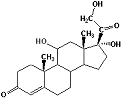
We don't need to tell our regular readers that cortisol, the hormone that's released when we're under stress, can have a disastrous effect on your body. The epidemiological study that British researchers published in Obesity confirms this yet again. The Brits were able to show that a chronically raised cortisol level dramatically increases the chance of overweight.
Study
Results

The researchers observed a similar relationship between cortisol and waist circumference. The men had higher cortisol levels in their hair when their waist measurement was 102 cm or more. The women had more cortisol in their hair when their waist measurement was 88 cm or more.
The relationships between cortisol, overweight and a thick waist were statistically significant.
Mechanism
"In addition to influencing fat deposition, cortisol is associated with alterations in the quantity and type of foods consumed. Laboratory studies in humans have shown increased ad libitum caloric intake in response to glucocorticoid infusion and artificially induced stress. [Am J Physiol. 1996 Aug;271(2 Pt 1):E317-25.] [Psychoneuroendocrinology. 2001 Jan;26(1):37-49.]"
"In addition to absolute changes in energy intake, functional MRI studies have indicated that the sensitivity of central food reward circuits is lower during times of stress, which may increase cravings for 'comfort foods'. [Int J Obes (Lond). 2010 Jan;34(1):172-81.] Under stress, there is a shift in preference toward more palatable, energy-dense foods irrespective of whether total energy intake increases. [Physiol Behav. 2006 Apr 15;87(4):789-93.] [Psychosom Med. 2000 Nov-Dec;62(6):853-65.]"
Conclusion
"Hair cortisol offers a suitable and easily obtainable measure for assessing chronically elevated cortisol concentrations in obesity research and may therefore aid in further advancing understanding in this area."
"While cross-sectional studies have provided a good starting point from which to explore the role of hypothalamic-pituitary-adrenal axis dysregulation and chronic cortisol exposure in the development of obesity, longitudinal research is needed in order to clarify the direction of associations."
Source:
More:
Archives:
|
|
||||||||||||||||