|
Can't train? Keep on using those BCAAs...
Strength athletes who for whatever reason are unable to train for a couple of weeks can reduce their muscle decay by using BCAAs. An animal study that Japanese researchers at Kobe University published in Nutrition Research suggests that BCAAs inhibit catabolic processes in inactive muscles.
Study
Inactive muscles wither so quickly that space trips take a heavy toll on cosmonauts, and forced bed rest can cause extra problems for patients who are in recovery. For this reason scientists are keen to find nutritional strategies that doctors can use to prevent muscle decay as a result of inactivity. They have had some success in the past with creatine and leucine.
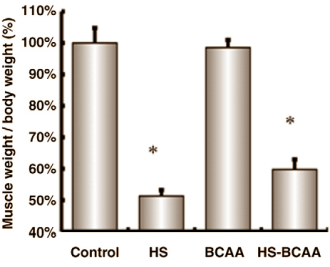
In many of the studies researchers use rats whose hind legs have been temporarily disabled [HS]. There's a picture of how these animals look at the top of the page. Rats in a control group were able to use their hind legs normally [Control].
Half of the animals in each group were given 600 mg BCAAs per kg bodyweight daily. The BCAAs were produced by Ajinomoto. The human equivalent of the dose used would be 100 mg BCAA per kg bodyweight. So if you weigh 90 kg that would amount to 9 g per day.
Results
The figure below shows that, while BCAAs couldn't prevent inactivity from leading to decay of the soleus muscle, administration did mitigate the breakdown. The photos below show that BCAA supplementation did reduce the decrease in the muscle cell size.


The figure above reveals how BCAA supplementation works at molecular level. The amino acids reduced the production of catabolic proteins such as atrogin-1 and MuRF1.
Conclusion
"In conclusion, BCAA protected against soleus muscle atrophy induced by hindlimb suspension and decreased atrogin-1 and MuRF1 protein levels, suggesting the possibility that BCAA protects against muscle atrophy, at least in part, via the inhibition of the Ub-proteasome pathway", the researchers write. "Oral BCAA administration appears to have the potential to protect against immobilization or microgravity-induced muscle atrophy."
Source:
Nutr Res. 2012 Sep;32(9):676-83.
More:
BCAAs inhibit fat mass growth 04.08.2012
You'll get more out of your plyometrics with BCAAs 04.07.2012
Endurance athletes acidify less fast with BCAAs in sports drink 20.01.2012
|

